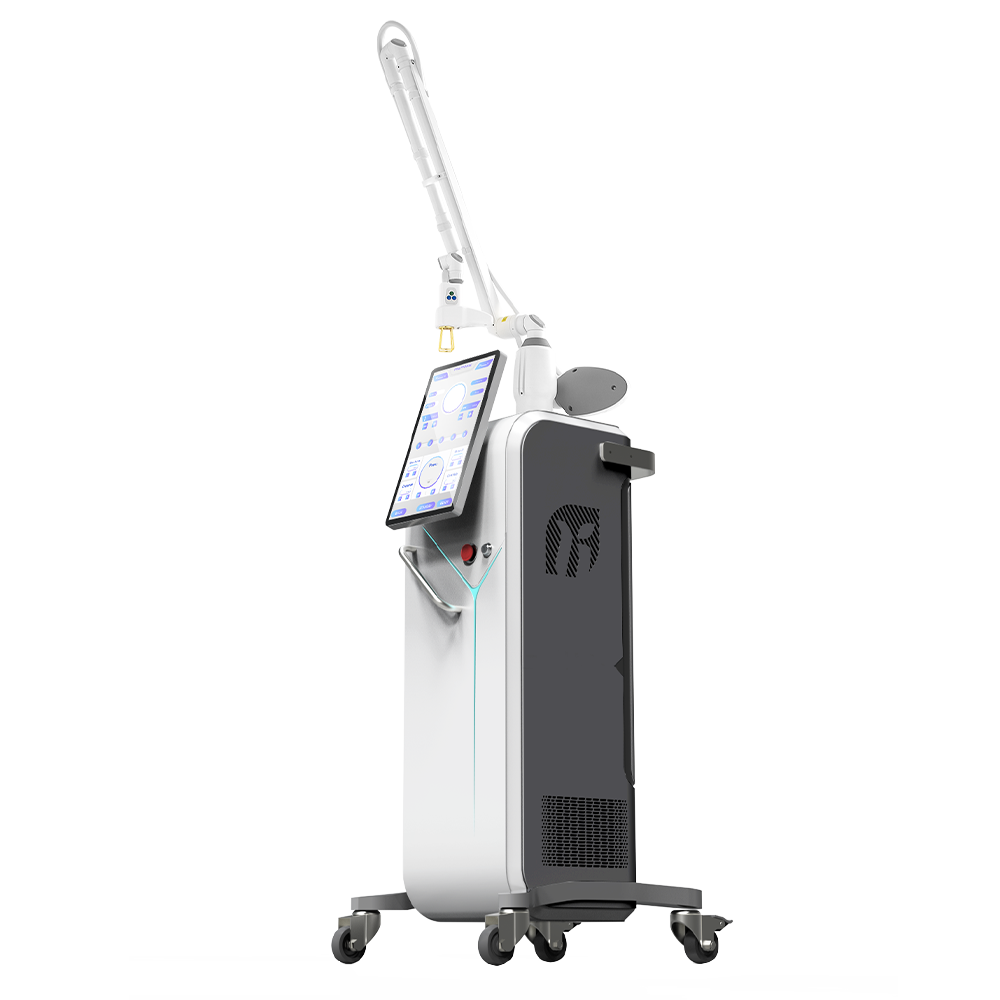

Skin rejuvenation refers to various techniques used to smooth, firm, even, or restore the appearance of the skin. As people age, their skin condition generally suffers from aging and other issues, leading to an increasing demand for safe and effective skin rejuvenation and anti-aging technologies year by year.
Fortunately, significant advancements in laser technology have provided effective and diverse options for skin rejuvenation and anti-aging.
Peeling and non peeling lasers are commonly used for the treatment of skin rejuvenation. The definition of laser ablation is the ability to generate sufficient thermal damage, resulting in complete tissue ablation or destruction of the treatment area. The target tissue of these stripping lasers is water, mainly including carbon dioxide (10600nm) and Er: YAG (2940nm) lasers. Non ablative laser produces limited thermal damage without causing tissue ablation or vaporization. 1927nm thulium laser and 1550nm erbium fiber laser are relatively popular.
Some laser devices also use 1440nm 1470nm infrared lasers. With the emergence of lattice photothermal theory, the risks and side effects of laser therapy in skin rejuvenation treatment have been significantly reduced, leading to an increasing application of lattice laser in skin rejuvenation treatment.
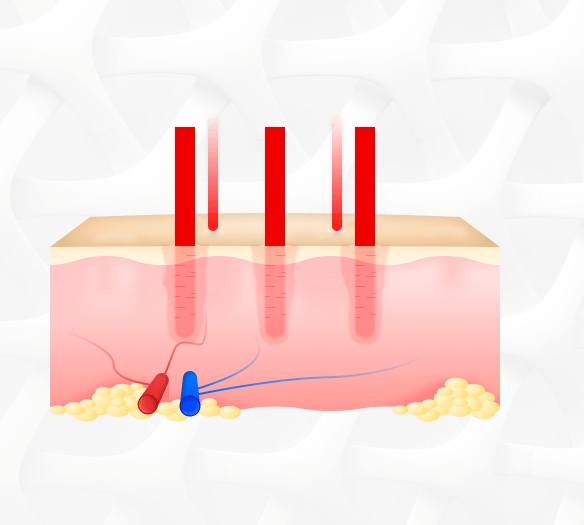
Since the beginning of the 21st century, non ablative dot matrix lasers have been widely used in the treatment of skin rejuvenation. Mid infrared lasers of different wavelengths are absorbed by water in the skin, and as the wavelength increases, the penetration depth becomes shallower. In addition, wavelength is related to laser scattering, and energy can diffuse outside the laser beam, producing effective heating of the dermis.
Dot matrix technology refers to a technique that can cause skin tissue to form a lattice distribution columnar thermal solidification after absorbing laser energy and heating up. This technology can ensure the integrity of the epidermis, while outside the treatment area of the dot matrix distribution, there are still a large number of intact skin that has not been irradiated by laser, which greatly accelerates skin healing and reduces skin repair time. Non ablative dot matrix laser has been proven in clinical applications to effectively improve skin texture with minimal risk and no recovery period.
Renuva represents Wingderm's next-generation non ablative dot matrix laser technology, with a wavelength of 1550nm and combined with optical tracking technology, making it the best choice for dermatologists and beauticians. The system provides 5 replaceable treatment heads, and operators can freely switch between "stamp" mode and "optical tracking" mode. The target tissue of Renuva is water, which generates limited thermal damage without causing tissue ablation or vaporization. The introduction of dot matrix technology ensures the integrity of the epidermis during the treatment process.
After a certain course of treatment, the skin's photoaging, texture, fine wrinkles, and sagging are significantly improved. Cryoshot ® As an optional cooling system for Renuva, it can protect the epidermis and reduce pain during the treatment process.